
The Oxygen Problem (and How We Solved It)
Late last winter, we noticed Bit, one of “The Boys,” had stopped eating and was floating a little weirdly. The Boys are a group of non-releasable male painted turtles who were surrendered at various times during 2024. Little and Bit came in together, included with a surrender of several exotic turtles to another rescue who is not licensed for natives and passed them on to us. Bit was swimming slowly and tipped to one side, signaling a respiratory infection. He was scooped out, moved to a dry tub, and started on antibiotics, but it was too late. Within a couple of days, his breathing became labored and he died.
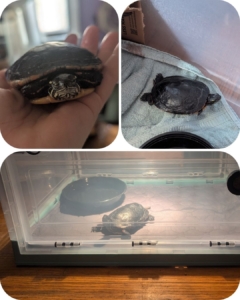 Meanwhile, Little also started showing symptoms and we began treating him, too. Turtles do not have a diaphragm nor can they move their ribs (ribs = shell), so they rely on a combination of other muscles to pump air in and out. That unique physiology creates problems when an infection takes hold. Turtles cannot cough to clear mucus. It builds up in their lungs and usually concentrates on one side affecting their buoyancy, which is why Little and Bit were tilting to one side in the water. Also, being in a weakened state means they do not have the energy to use those other muscles to breathe. That leads to insufficient oxygen to function at a normal level.
Turtles are very efficient in their use of oxygen. Their red blood cells are bigger than ours so they can hold onto much more oxygen than we can. That is one of the reasons turtles can spend the winter underwater. They may need extra oxygen when they are ill or injured, though, and they cannot get it if their respiratory system is compromised. That efficient oxygen use also hides respiratory problems until they are advanced. When we noticed Little’s slight tilt while he was swimming, we were afraid it might be too late for him, too. We needed to solve the oxygen problem.
It is hard to put an oxygen mask on a turtle who can just pull his head into his shell and out of the mask, so we needed to set up an oxygen tent. We had already been thinking about getting a large incubator, like those used for puppies and kittens, to have on hand for gradually warming turtles who were cold stunned or injured in early spring. We found a great one that was easy to clean, large enough for all but the biggest snapping turtles, and had the fittings for oxygen tubing. We ordered that right away, knowing the heat would be supportive for Little, at least, but our small budget did not include funds for the oxygen concentrator we would need to turn it into an oxygen tent.
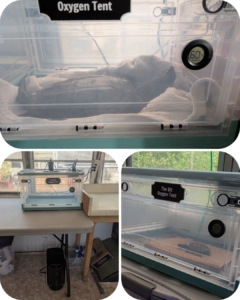 Luckily for Little, one of our social media followers made an anonymous donation to fund the oxygen concentrator. We ordered it right away and put it to use the moment it arrived. Little rested in the pre-warmed incubator receiving extra oxygen with each breath. Thanks to that wonderful donor, Little had exactly the supportive care he needed and recovered. By spring, he was happily swimming around with the other Boys again.
We put the “Bit Oxygen Tent,” named in honor of our lost turtle, to use throughout injured turtle season for some of our toughest cases. They did not all survive, but some revived enough to hang on while we treated their injuries. We are celebrating our successes and are very grateful to the donor who made them possible.
None of the other Boys developed respiratory infections, so we believe Little and Bit contracted an illness from the exotic turtles they had been housed with prior to their surrender which became exacerbated during the cooler conditions in their winter housing. Exposure to new pathogens is not just a problem for turtles kept as pets. When exotic turtles, like red eared sliders, are released into new areas, they expose native turtle populations to viruses and bacteria their immune systems have never seen before. A turtle who becomes ill during winter brumation will likely die. Please do not release pet turtles into the wild. And if you see a turtle with mucus on their nose or swimming tilted to one side and never righting themselves, please contain the turtle and call a wildlife rehabilitator right away.