2025 was a busy year for our wildlife rehabilitators. While we taken in more injured turtles in other years, we had a record number of frogs and toads. Here’s the breakdown:

We were able to release 21 of the patients that came in during 2025. We are overwintering 11 turtle patients who were not ready for release in September, six clutches of baby turtles who hatched in our incubators, and 10 turtles from prior years who are not expected to be releasable and will likely become educational ambassadors in the future.
While every turtle who comes in is important to us, we had some special cases last year we wanted to share with you.
Art
 Art was the first turtle to arrive in 2025 and he came in with an injury we had never seen before. This male painted turtle was found on a road that crosses through a wetland, bleeding from minor shell cracks on his rear end, most likely from a vehicle strike. During his exam we discovered that he also had a hole through his front foot. We don’t know if he stepped on something walking or when he got hit, but it went straight through from the top of his foot to the bottom.
It was challenging to keep the wound clean and his foot stable, because painted turtles are not good at sitting still, but we were able to prevent infection and keep everything aligned while the hole closed. Art was released in September his foot had healed and he was walking and swimming just fine.
Carl
 When a message went out from the North Country Wild Care hotline that a snapping turtle had been spotted with fishing tackle coming out of his mouth, we put our nets and waders into the car and set out on a rescue mission. Unfortunately, Carl was not sure he wanted to be rescued. He was hanging out near a public beach and boat docks and was clearly in distress, because he was trying to find a way to climb out of the water. Carl took off whenever we got close, though, and disappeared under the docks. After three hours, we found him tucked under the concrete wall of the pier and one of us was able to crawl under the dock and grab him. On examination, we could see that Carl had swallowed the hook and it was too far down to extract it. We called the Janet L. Swanson Wildlife Hospital at Cornell University at midnight and were on the road first thing in the morning for the four hour drive to the hospital. There, the amazing veterinary surgeons went in through the base of Carl’s neck to remove the hook. Luckily there was no permanent damage to his esophagus.
Carl came back to us after a week and stayed for another five weeks until his stitches were ready to come out. During his stay, Carl made up for however much time he had been unable to swallow and ate lots of fish. We were especially grateful to our donors because our food expenses were quite high while Carl was in care. Carl was released back to his beach at sunrise while it was quiet and he swam off, healed and with a full belly.
Willow
 It is rare to get a northern map turtle in for care, and Willow’s reason for admission was a strange one. A kayaker noticed her hanging upside down, caught in a crack in the rock wall bank of the river, about three feet above the waterline. The kayaker freed her from the rocks but, when she put her in the water, Willow was not able to right herself or swim. She scooped her up again and put Willow in her kayak. When the finder reached out, we suspected she had respiratory complications from hanging upside down and brought her in. Willow was mildly dehydrated and had some scrapes on her shell from the rocks. We treated those as well as a potential respiratory infection and let her rest so her lungs would heal.
While Willow was with us, she showed us how much she liked to “hang out.” Whenever she was in for a soak, she draped herself over the edge of the tub or, sometimes, climbed up and balanced on the edge. After watching her antics, we were less surprised she got herself into the predicament she did. She also surprised us by laying eggs in her tub, because we never felt them and she had not acted like a gravid female turtle. We came to believe that she had been looking for a place to nest and either slid off the top of the rocks or fell trying to climb them when she got stuck. Unfortunately, the eggs were laid so late that they were no longer viable, but Willow went home to the river and will get another chance to nest this year.
WT
 We love wood turtles, so when another wildlife rehabilitator asked for help getting one who had been a challenging long-term patient ready for release, we said yes. WT had been hit by a car in 2024 and one of his injuries was a broken jaw. He was cared for at the Janet L. Swanson Wildlife Hospital and cleared for release in the spring, but developed an infection in his jaw over the winter. After more trips to Swanson to treat the infection, he healed fully but showed little interest in food. Worried that he would not be able to fend for himself in the wild, the other rehabber sent WT to us to see if we could get him behaving like a wood turtle.
Hoping that he just needed a more natural environment for his instincts to kick back in, and since we had the funds available thanks to our generous donors, we purchased an extra-large raised garden frame and set it up on the ground in Turtle Hall, our outdoor enclosure where aquatic turtles spend some time in large stock tanks to readjust to natural sunlight and weather. What we thought WT needed was dirt, because wood turtles spend summers mostly on land. We dug a hole for a large soak tub and added a bubbler to move the water as an imitation stream, borrowed a hide from our opossum supplies, and added some plants.
It was a success! WT started eating the wood turtle salads we made him, especially the earthworms we topped them with. Worms are wood turtles’ favorite food and they will dig them up and even stomp on the ground with their front feet or the front of their plastron to trick the worms into thinking it is raining so they come to the surface. Once WT was eating well from a dish and behaving like a wood turtle should, we started putting worms in the dirt for him to find. He dug for them and we even got to witness the worm stomp! Confident that he could find food on his own, we took WT home in September. We are sure he was happy to return after 16 months in care. Kay, the rehabber who originally cared for WT and got him through so much, joined our board of directors at the end of last year. We’re happy to have her as part of the Dancing Turtle rehab team in 2026.


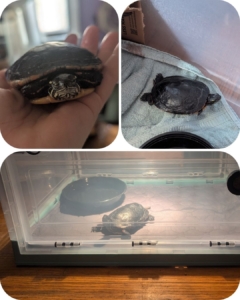 Meanwhile, Little also started showing symptoms and we began treating him, too. Turtles do not have a diaphragm nor can they move their ribs (ribs = shell), so they rely on a combination of other muscles to pump air in and out. That unique physiology creates problems when an infection takes hold. Turtles cannot cough to clear mucus. It builds up in their lungs and usually concentrates on one side affecting their buoyancy, which is why Little and Bit were tilting to one side in the water. Also, being in a weakened state means they do not have the energy to use those other muscles to breathe. That leads to insufficient oxygen to function at a normal level.
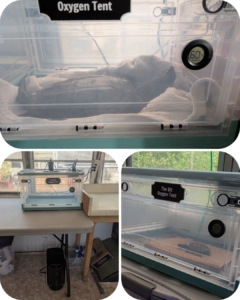 Luckily for Little, one of our social media followers made an anonymous donation to fund the oxygen concentrator. We ordered it right away and put it to use the moment it arrived. Little rested in the pre-warmed incubator receiving extra oxygen with each breath. Thanks to that wonderful donor, Little had exactly the supportive care he needed and recovered. By spring, he was happily swimming around with the other Boys again.